

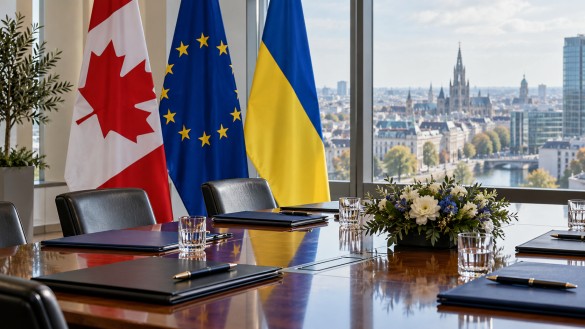
The European Union and Canada have jointly pledged to intensify their pressure on Russia while continuing to provide extensive military, financial, and diplomatic support to Ukraine. This commitment was announced during the 21st EU–Canada summit held in Montreal on October 30, where Canadian Prime Minister Mark Carney met with European Commission President Ursula von der Leyen and European Council President António Costa.
A significant development from the summit was Canada’s announcement of its intention to participate in the EU’s €90 billion Ukraine Support Loan planned for 2026–2027. This initiative would enable Ukraine to purchase military equipment from Canadian defense companies, utilizing European financing. This could potentially enhance Kyiv’s access to weaponry and foster cooperation between the Canadian and European defense sectors.
Meanwhile, the European Commission is moving forward with plans to release an additional €45 billion to support Ukraine in 2027. Of this funding, €31.7 billion is earmarked for bolstering Ukraine’s defense industry, while up to €13.3 billion will assist with the state budget, facilitated through the Ukraine Facility and macro-financial aid. Approval from the Council of the European Union is required, with the goal of making these funds available by the end of 2027. This financial support is crucial for helping Ukraine maintain essential public services and continue its defense against Russian aggression.
EU leaders emphasized the urgent need for military supplies such as drone interceptors, ammunition, missiles, and air defense radars. The European Commission reaffirmed its commitment to boosting European defense production to ensure timely deliveries to Ukraine. Although Canada’s proposed participation in this procurement framework could provide additional military resources, Ottawa has yet to finalize a specific agreement or announce its financial contribution.
In a joint declaration, European and Canadian leaders reiterated their support for Ukraine’s sovereignty and territorial integrity within its internationally recognized borders. They also pledged to increase pressure on Russia and seek accountability for crimes committed during the invasion. The leaders advocated for a comprehensive, just, and lasting peace based on international law and the United Nations Charter, and called for the safe return of Ukrainian prisoners of war and civilians, including children, unlawfully deported or transferred by Russia.
The declaration also underscored the importance of the International Coalition for the Return of Ukrainian Children, a diplomatic initiative in which Canada has played a significant role. Beyond immediate military support, the EU and Canada reaffirmed their commitment to Ukraine’s long-term reconstruction, institutional reforms, and closer integration with European and transatlantic structures.